


The Moon's cratered surface against deep space, with sunlight flaring over its edge
EngiRank logo

TOP-310 Universities of Technology in Europe

2026 edition

European Engineering Rankings

EngiRank — Full Report 2026

EngiRank — Full Report 2026

Free copy — we'll e-mail you the link.

EngiRank 2026 announced - the best technical universities in Europe revealed
Featured

November 23, 2026

EngiRank 2026 announced - the best technical universities in Europe revealed

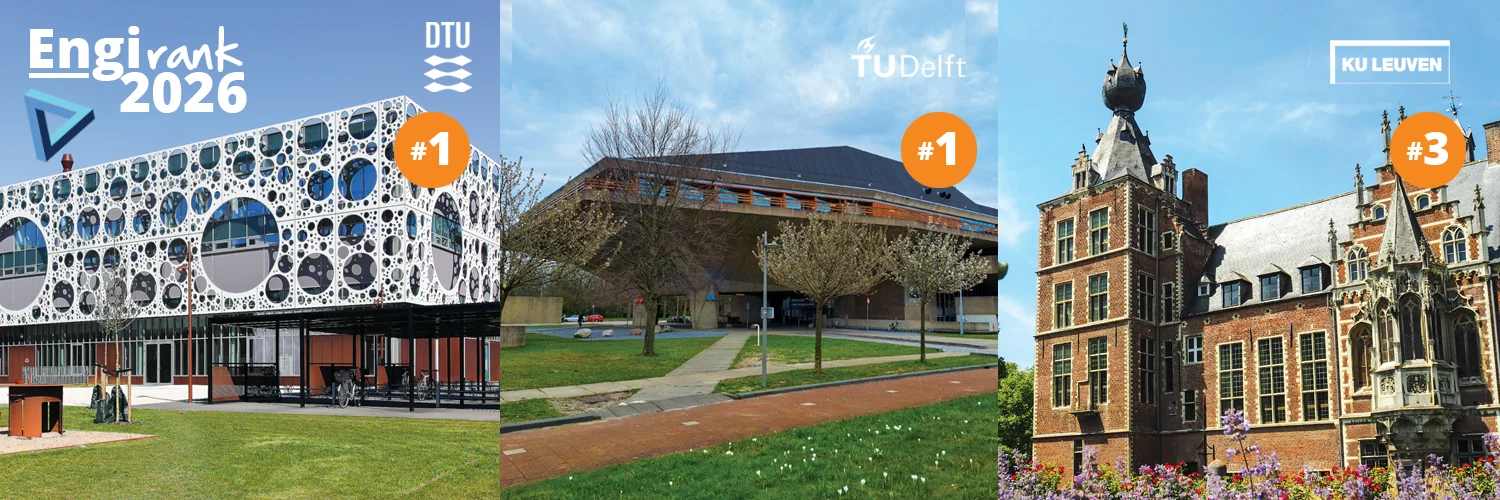
The Technical University of Denmark (DTU) and Delft University of Technology (Netherlands) share the top spot in the EngiRank 2026 ranking of Europe’s best engineering schools, followed by KU Leuven (Belgium) in third place. For the fourth consecutive year, the "Perspektywy" Education Foundation has published a ranking of European universities offering engineering programs. The ranking includes 310 higher education institutions in 37 European Higher Education Area (EHEA) countries. “The future of international rankings belongs to rankings that are regional and according to disciplines (by subject)” said Waldemar Siwiński, head of EngiRank.

Institutional Ranking — Methodology

The Institutional Ranking is based on five criteria covering research performance, innovation, contribution to sustainable development, internationalisation and multidisciplinarity.

Each criterion carries a specific weight in the overall score, and is in turn built from indicators with weights of their own — set out in full below.

Weight in the overall score
  • Research28%
  • Innovation25%
  • Multidisciplinarity21%
  • Internationalisation16%
  • SDG 910%

Five criteria, 100% in total.

1. Research — 28%

Assesses the institution’s research output, quality, citation impact and its development over time, based on Scopus data for 2021–2025 in Engineering and Technology (FORD).

2. Innovation — 25%

Measures the institution’s ability to translate research into innovation through funding, patenting and cooperation with industry for 2021–2025.

3. SDG 9: Industry, Innovation and Infrastructure — 10%

Evaluates the institution’s contribution to UN Sustainable Development Goal 9.

4. Internationalisation — 16%

Assesses international research cooperation, its impact and participation in European university alliances (2021–2025).

5. Multidisciplinarity — 21%

Rewards institutions for their breadth and performance across subject rankings, with 3% allocated to each of the seven EngiRank subject rankings.

Indicators and their weights

Indicators and weights in the EngiRank institutional ranking
IndicatorWeightWhat it measures
Research — 28%
Publications10%Number of publications indexed in Scopus.
Publications in Top 10%6%Percentage of publications in journals ranked in the top 10%.
Citations6%Average number of citations received by publications.
Change of Impact6%Change in FWCI between 2021–2025 and 2016–2020.
Innovation — 25%
Research and Innovation Funding10%Value of grants awarded under Horizon Europe adjusted for purchasing power parity (PPP).
Patents5%Number of patents granted by the European Patent Office.
Patent-Citation Count5%Average number of patent citations per scholarly publication.
Academic-Corporate Collaboration5%Percentage of publications co-authored with partners outside academia.
SDG 9 — 10%
SDG 910%Number of publications (2021–2025) assigned simultaneously to SDG 9 and the Engineering and Technology field (FORD).
Internationalisation — 16%
International Collaboration10%Percentage of international publications.
International Collaboration Impact2%Citation impact of internationally co-authored publications.
European University4%Indicator confirming full membership in a European university alliance.
Multidisciplinarity — 21%
EngiRank subject rankings21%Results achieved in the individual EngiRank subject rankings — 3% for each of the seven subjects.

Rankings by Subject — Methodology

The EngiRank subject rankings cover seven engineering disciplines. Four of them — chemical, electrical/electronic/information, materials and mechanical engineering — are assessed on Research, Innovation and Teaching Quality. Civil, environmental and medical engineering also include a Contribution to SDGs criterion, reflecting their respective contributions to SDG 11, SDG 6 and SDG 3.

Research

Research output in the relevant discipline, its quality, citation impact and development over time — publications, share in top 10% journals, citations and the change of impact, from Scopus data for 2021–2025.

Innovation

The ability to translate research into innovation through Horizon Europe funding and publications co-authored with partners outside academia, for 2021–2025.

Teaching Quality

The number of engineering degree programmes in the relevant discipline holding valid accreditation in 2026 from ENAEE-authorised agencies (EUR-ACE label), ABET or RIBA.

Contribution to SDGs

For three disciplines only: publications (2021–2025) assigned simultaneously to the discipline and to SDG 3 (Medical), SDG 6 (Environmental) or SDG 11 (Civil Engineering).

Indicator weights by discipline

The table below provides an overview of the weightings assigned to the indicators in the individual subject rankings.

RANKINGS BY SUBJECT Publications Publications in Top 10% Journals Citations Change of Impact Academic-Corporate Collaboration Research and Innovation Funding Accreditations SDG 3 SDG 6 SDG 11
Chemical engineering 16% 16% 16% 16% 16% 10% 10% - - -
Civil engineering 15% 15% 15% 15% 15% 10% 10% - - 5%
Electrical eng., electronic eng., information engineering 16% 16% 16% 16% 16% 10% 10% - - -
Environmental engineering 15% 15% 15% 15% 15% 10% 10% - 5% -
Materials engineering 16% 16% 16% 16% 16% 10% 10% - - -
Mechanical engineering 16% 16% 16% 16% 16% 10% 10% - - -
Medical engineering 15% 15% 15% 15% 15% 10% 10% 5% - -

Study engineering in Poland

Be Smart! Study Engineering in Poland

Not sure which studies to choose? Europe needs engineers — choose Poland!

6
technical universities
+94 000
students
143
degree programmes taught in English
+714
student science clubs

Ready to Explore European Engineering Excellence?

Discover comprehensive rankings, detailed university profiles, and insights that will help you make informed decisions about engineering education in Europe.