
Europe in the Shadow of Drones – Universities and Industry in the Service of Defence
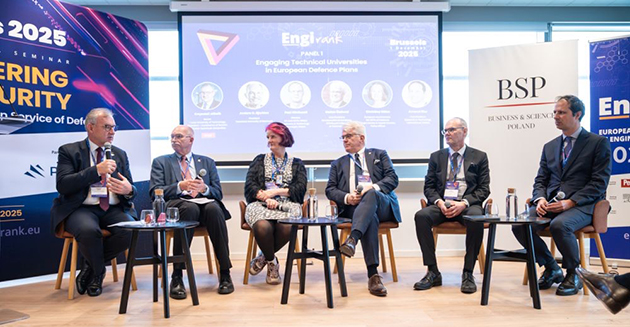
The involvement of technical universities in European defence plans – summary of a panel held on 1 December 2025 in Brussels during the seminar "Engineering for Security: Universities and Industry in the Service of Defence", organised by the Perspektywy Foundation.
In the face of growing instability in Europe, especially in the context of Russia's aggression against Ukraine, security has become a priority for both EU Member States and the European Commission. The modernisation of defence today requires not only increased financial outlays but, above all, advanced technologies that can be developed through the active engagement of technical universities. During the panel devoted to cooperation between universities and the defence industry, speakers emphasised that the development of European defence capabilities requires collaboration, long-term trust, and the combination of academia's strengths with industry needs.
The panellists were:
- Krzysztof Jóźwik, Rector of Lodz University of Technology
- Anders O. Bjarklev, Rector of the Technical University of Denmark (DTU)
- Pasi Niinikoski, Director for EU and NATO Affairs, Patria
- Stefan Östlund, Vice President for International Collaboration, KTH Royal Institute of Technology
- Christina Wilen, European Commission, DG DEFIS
- Arnaud Riss, Vice President for International Development, Safran
Anders O. Bjarklev, Rector of DTU, reminded the audience that the fundamental role of universities is to educate talent and conduct research that brings tangible value to society. “We cannot be a company’s R&D department – our mission is education and research. But for our results to be useful to the defence industry, we must engage in dialogue with that industry and understand its needs,” Bjarklev said. He also noted that universities should focus on their strengths, such as quantum technologies, biotechnology and electronics, while leaving more sensitive areas to other partners.
Stefan Östlund of KTH Royal Institute of Technology highlighted the importance of a partnership-based approach. "We are not doing this solely for society – we are part of society. We must work with both the defence industry and local authorities to better understand needs and challenges," he said. He also stressed that in the case of large, complex problems, cooperation among multiple universities is essential, as a single institution may not be able to deliver a comprehensive solution.
Pasi Niinikoski of Patria emphasised that creating innovation ecosystems is the best model for cooperation between industry and academia. “We connect companies with academic centres – this is how relationships emerge that enable the development of operational capabilities. These are not one-off projects, but long-term cooperation,” he explained. He added that similar models should be developed at the EU level, for example within the “EU Tech Forerunners” concept, where integrated companies take greater responsibility for the development of the entire ecosystem.
Arnaud Riss of Safran drew attention to the practical importance of university infrastructure. "We don't have time to build new test facilities, which can take 5–10 years. That's why using university infrastructure allows industry to carry out demonstrations and implement new technologies faster." He also underlined that at low TRL levels there is no difference between civil and defence applications, enabling universities to develop technologies without restrictions resulting from military secrecy.
Krzysztof Jóźwik, Rector of Lodz University of Technology, pointed to challenges related to information sharing and trust. “If we decide to cooperate, we must have full trust and an exchange of information in order to thoroughly develop and find a solution to the problem. History shows that intellectual property constraints often prevent the full use of research results.”
Christina Wilen of DG DEFIS emphasised that building trust requires time and a systemic approach. "The European Defence Fund (EDF) is an effective tool for integrating research institutes with industry, enabling the transition from research to operational capabilities. It is also important for universities to support industry in recruiting students and graduates, even in areas requiring enhanced security."
The panellists agreed that the key elements are long-term cooperation, a focus on universities’ strengths, clear rules on intellectual property, and support for the exchange of experience and students. Importantly, activities should not be limited solely to advanced research projects but should also include internships, thesis projects and industry days. This enables trust to be built gradually, joint projects to develop, and technologies to be prepared that will have real-world applications in defence.
Technical universities are indispensable partners in building European defence capabilities. Their engagement, combined with industry and institutional support, not only makes it possible to develop innovative technologies but also strengthens the security of Europe as a whole.
Prepared by AR